

Top Mistakes Technology Vendors Make When Entering Government Contracting
Government contracting can be a strong growth channel for technology vendors, but many companies enter too broadly, chase RFPs too late, confuse interest with pipeline, or underestimate readiness requirements.
For vendors evaluating SLED market entry, public-sector growth requires more than interest, activity, and visible RFPs.
Government contracting can look attractive to technology vendors. Public-sector buyers need modernization, infrastructure, cybersecurity, cloud support, data tools, managed services, digital workflows, and more resilient technology environments.
But market need does not automatically create a qualified opportunity. Vendors that struggle often do not fail because their technology lacks value. They struggle because they enter the market without enough discipline around fit, procurement path, buyer timing, positioning, and pursuit readiness.
Here are some of the most common mistakes technology vendors make when approaching government contracting and SLED growth.
Mistake 1: Treating market size as market access
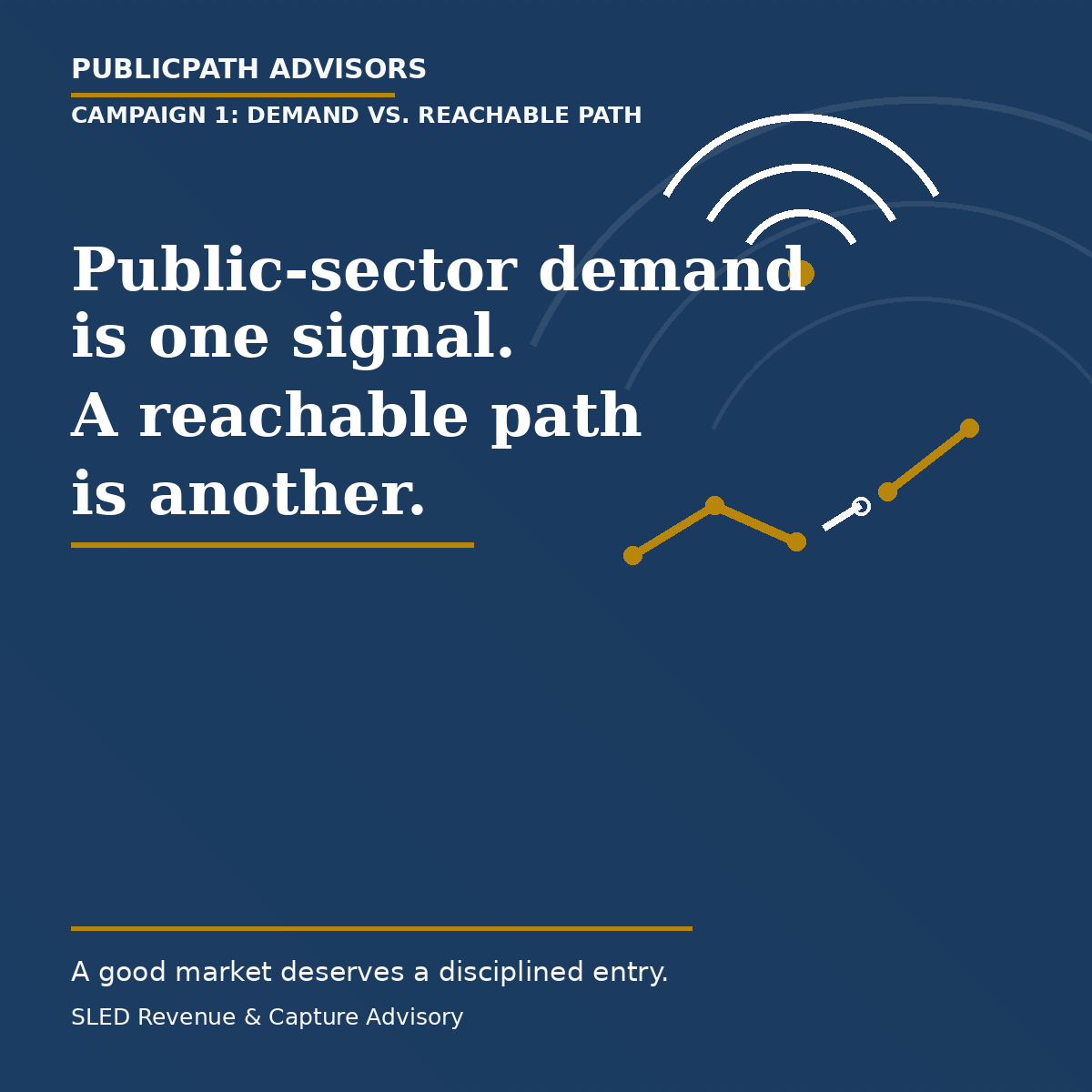
The public-sector market is large. That does not mean it is immediately reachable.
A vendor may see a large total addressable market, a major funding trend, or a broad agency need and conclude that the opportunity is ready.
But market size does not answer the practical questions:
Which buyers are the right fit?
How do they buy?
When do they buy?
What contract paths matter?
Who influences the decision?
What proof points are required?
What internal readiness is needed?
Which opportunities should be avoided?
A large market can still be difficult to enter without a clear path.
Mistake 2: Starting with RFPs
Many vendors begin by looking for RFPs.
That is understandable. RFPs are visible, searchable, and concrete. They create the feeling that the opportunity is real.
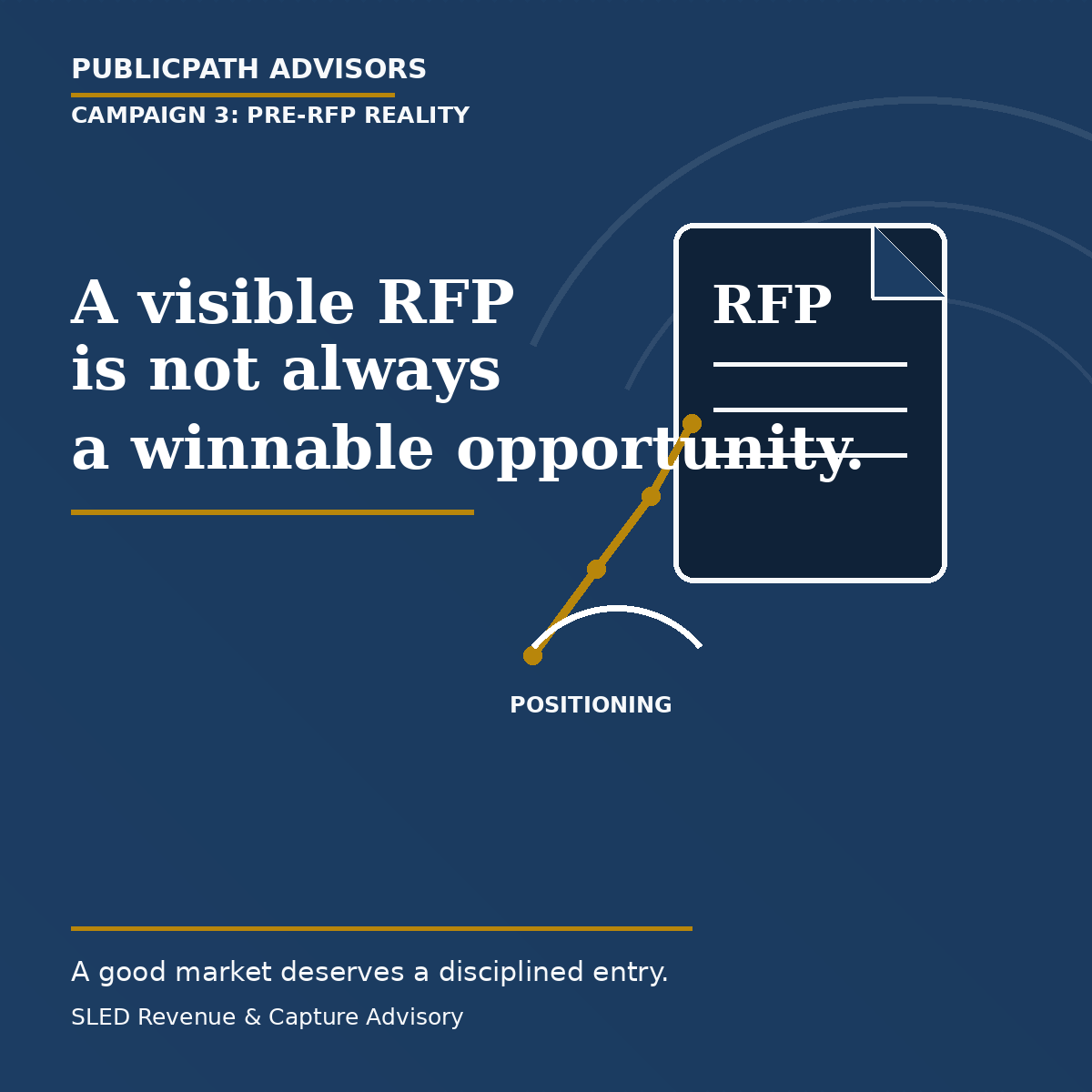
But RFPs can also create false confidence.
By the time an RFP is public, the buyer may already have shaped the need, defined the requirements, spoken with incumbent providers, gathered internal input, and established evaluation priorities.
A vendor can spend significant time responding to an opportunity it was never well-positioned to win.
The better approach is to qualify the pursuit before committing proposal resources.
Mistake 3: Confusing interest with pipeline
A positive conversation with a public-sector contact is useful.
It is not the same as qualified pipeline.
In SLED, buyer interest must be tested against procurement path, funding, timing, stakeholder alignment, authority, urgency, and competitive position.
A buyer may like the solution but have no near-term purchase path. A department may have pain but no budget. A technical contact may see value but lack decision authority. A procurement process may be required before any real movement occurs.
Vendors need to distinguish curiosity from opportunity.
Mistake 4: Using commercial messaging without adapting it
Technology vendors often enter government markets with commercial messaging that worked elsewhere.
That messaging may focus on speed, growth, disruption, innovation, or competitive advantage.
Public-sector buyers may care about those things, but they also care about risk, continuity, compliance, public accountability, procurement defensibility, implementation burden, data protection, stakeholder impact, and long-term support.
The message must translate.
The public-sector buyer needs to understand not only what the solution does, but why it fits their environment and how it can be adopted responsibly.
Mistake 5: Underestimating procurement complexity
Procurement is not just a final step.
It is part of the opportunity.
Vendors that ignore procurement path until late in the sales cycle may discover that the buyer cannot purchase directly, needs a different contract vehicle, requires a formal solicitation, or must align with budget timing.
This can stall or kill otherwise promising opportunities.
Procurement-path awareness should be part of early qualification.
Mistake 6: Assuming a contract vehicle creates demand
Contract vehicles can matter. They can reduce friction and create a compliant path to purchase.
But a contract vehicle does not sell the solution.
It does not create buyer urgency. It does not replace account development. It does not establish trust. It does not define messaging. It does not qualify the opportunity.
A contract vehicle may open a door. It does not build the motion.
Mistake 7: Chasing too many agencies at once
SLED can tempt vendors into broad outreach.
States, cities, counties, school districts, higher education institutions, and public agencies all become possible targets.
But possible is not the same as practical.
A vendor with limited resources needs focus. It should prioritize accounts and segments where fit, need, timing, procurement path, and solution relevance are strongest.
Broad activity can create the appearance of progress while diluting execution.
Mistake 8: Entering without internal readiness
Selling to government buyers requires internal discipline.
The vendor may need public-sector messaging, pricing clarity, contract awareness, security documentation, references, implementation capacity, procurement support, proposal discipline, partner strategy, and executive patience.
If the internal team is not prepared, early market activity can create confusion and friction.
A public-sector growth motion should be built intentionally.
Mistake 9: Responding before qualifying
Some vendors respond to public-sector opportunities because the opportunity looks relevant.
But relevance is only one factor.
Before responding, vendors should ask:
Do we understand the buyer’s problem?
Are we positioned before the solicitation?
Do we meet the requirements?
Is the timeline realistic?
Do we have the right proof points?
Is there an incumbent?
Is the evaluation likely aligned to our strengths?
What will it cost us to pursue?
What is the probability of a meaningful outcome?
Not every visible opportunity deserves a response.
Mistake 10: Expecting immediate revenue
SLED growth can become a durable revenue channel, but it rarely rewards impatience.
Vendors that expect quick wins may overreact when early efforts do not convert immediately.
The better approach is to build a disciplined path: assess fit, understand procurement, focus target accounts, refine messaging, qualify pursuits, and develop capture readiness over time.
The PublicPath perspective
Government contracting rewards preparation.
Technology vendors do not need to pursue every agency, every RFP, or every visible opportunity. They need to understand where they fit, how buyers can buy, which paths are realistic, and what readiness gaps should be addressed before they invest heavily.
The opportunity may be real.
The path still has to be qualified.
A good market deserves a disciplined entry.
PublicPath has also published market-entry and procurement-readiness resources to help vendors begin asking the right questions before they overcommit.

Understanding SLED Procurement Paths
Public-sector procurement is not just a final step in the sales process. For technology vendors entering SLED, procurement-path awareness is part of opportunity qualification, account planning, and market-entry discipline.
For technology vendors entering the public-sector market, procurement can feel like the hardest part of the SLED revenue motion. Without a clear understanding of public-sector procurement paths, it can also become one of the most expensive places to make assumptions.
Even when a vendor’s solution addresses a real agency need, the opportunity may not be viable if there is no realistic path to purchase.
In the public-sector market, the procurement path is not a minor administrative detail. It is a major part of opportunity qualification.
Procurement is part of the sales strategy
Vendors new to the public-sector market treat the procurement process as something that happens after the buyer is interested. That approach will waste valuable time, effort and energy.
An agency buyer may understand the problem, appreciate the vendor’s solution, and still be unable to purchase quickly or directly. Contingent on the dollar value, the buyer may no choice but to take it to bid. Agencies with state contract agreements in place (or other agency-approved contract vehicle approval), are authorized to proceed so long as they have budget authorization and board approval.
Even with budget authorization and board approval, you won’t be able to bypass the legally required procurement process.
This is critical: the earlier a vendor understands and aligns to the buying path and procurement process, the sooner they will be able to qualify the opportunity.
Procurement awareness will help a vendor answer important questions:
Is there a realistic path to purchase our services?
Does the buyer have authority and budget funding?
Is the timing aligned with budget cycles?
Will a public solicitation be required?
Is a contract vehicle required?
Has the opportunity been shaped by another vendor?
Is this a near-term pursuit or a longer-term positioning effort?
Vendors without a full understanding of the procurement path may mistake general interest for pipeline growth. A sales funnel of unqualified opportunities will catch up to you quickly.
Common SLED procurement paths
SLED procurement varies by state, agency, institution, and category. However, technology vendors commonly encounter several common paths.
1. Public RFPs and formal solicitations
A public RFP, RFQ, RFI, or similar solicitation is one of the most visible procurement paths.
Agency buyers (procurement team) define requirements, publish the opportunity, receive responses, evaluate and score vendors, and awards the business according to the stated process requirements.
This process is formal and transparent, but vendors entering after the solicitation is already public may have limited room to shape the opportunity.
For vendors still defining their public-sector entry path, a focused SLED Market Entry Sprint can help clarify fit, buying path, positioning, and next-step direction before activity builds around untested assumptions.
A highly recommended and critical service provided by public-sector experts with decades of SLED experience. They ensure you are prepared and better positioned to win future opportunities.
Note: by the time the solicitation is public, much of the opportunity may already be shaped. Requirements, evaluation language, budget assumptions, and internal stakeholder priorities may have been developed long before a vendor ever sees the posting.
Formal solicitations are an important public-sector process, and successful vendors know how to get in front of them earlier.
For vendors already reviewing opportunities, weighing procurement paths, or prioritizing public-sector accounts, the SLED Revenue & Capture Advisory Desk provides ongoing advisory support.
2. Cooperative purchasing contracts
Cooperative purchasing vehicles allow public-sector buyers to purchase from contracts that have already been competitively awarded through another approved entity or cooperative organization.
For vendors, these vehicles can reduce procurement friction when the buyer is allowed to use them and when the vendor’s solution is properly aligned to the contract scope.
A cooperative contract can be helpful, but it does not create demand by itself.
Having access to a contract vehicle does not replace buyer need, budget timing, stakeholder trust, solution fit, or sales execution.
The key question is:
Does this contract vehicle create a realistic buying path for this buyer and this use case?
3. Statewide or agency-specific contracts
Some states and agencies maintain approved statewide contracts, master agreements, or preferred purchasing vehicles for technology categories.
These can be especially important in IT, cybersecurity, hardware, software, cloud, telecom, and professional services.
For vendors, alignment with the right statewide or agency vehicle can improve access. But the vehicle must match the buyer’s purchasing rules and the vendor’s offering.
The key question is:
Is this the vehicle the buyer actually uses for this category of purchase?
4. Direct purchase or small purchase thresholds
Some public-sector buyers may be able to purchase directly under certain dollar thresholds or through simplified purchasing rules.
This can create entry opportunities for smaller engagements, pilots, assessments, workshops, advisory services, or limited-scope support.
For vendors, these smaller paths can be useful when the goal is to establish relevance, validate need, or create a lower-friction first engagement.
The key question is:
Can the buyer take a practical first step without triggering a larger procurement process?
5. Grant-funded or program-funded purchases
In some public-sector environments, technology purchases may be tied to grant funding, federal programs, state allocations, bond funds, capital plans, cybersecurity initiatives, education funding, or modernization programs.
Funding source matters because it may shape timing, eligibility, compliance, allowable uses, reporting requirements, and urgency.
A vendor that understands the funding context can better align messaging and qualification.
The key question is:
Is there a funding source that supports this type of purchase, and what conditions come with it?
6. Partner-led or channel-led paths
Some technology vendors reach SLED buyers through partners, resellers, systems integrators, MSPs, VARs, or prime contractors that already hold public-sector relationships or contract vehicles.
This can be a practical path for vendors that are not yet positioned to sell directly.
But partner-led paths require clarity. The vendor needs to understand the partner’s role, economics, contract coverage, account access, responsibilities, and control of the buyer relationship.
The key question is:
Does this partner improve access, or simply add another layer without a clear path?
Procurement path should shape qualification
A SLED opportunity should not be qualified only by need, interest, and budget.
It should also be qualified by path.
Vendors should ask:
What is the likely procurement route?
Is a formal solicitation required?
Is there an existing contract vehicle?
Is a cooperative contract acceptable?
Is the buyer already using a preferred vehicle?
Is a partner needed?
Is the purchase within a threshold?
Is funding available and usable?
What approvals are required?
What is the realistic timing?
These questions help separate real opportunity from vague interest.
The danger of procurement assumptions
Technology vendors often make three procurement mistakes.
First, they assume buyer interest means buyer ability.
Second, they assume a contract vehicle means access.
Third, they assume an RFP means an open opportunity.
All three assumptions can create wasted effort.
Public-sector procurement is not just a process to survive. It is a signal to understand.
The PublicPath perspective
For technology vendors entering SLED, procurement-path awareness should be built into market entry, account planning, opportunity qualification, and capture readiness.
The goal is not to become a procurement expert overnight.
The goal is to understand enough to avoid false starts, qualify better, and pursue opportunities where the path is real.
A good market deserves a disciplined entry.
For technology vendors evaluating SLED fit, market entry, or pursuit readiness, PublicPath provides a disciplined advisory layer to help avoid over-investing in the wrong activities, accounts, and pursuits.
Explore our broader SLED advisory services for public-sector fit, market entry, capture readiness, and pursuit discipline.
How Do Technology Vendors Sell to SLED?
Selling to SLED is not the same as selling to a commercial account. Technology vendors need to understand fit, buyer path, procurement realities, stakeholder alignment, and pursuit discipline before investing heavily in public-sector activity.
For many technology vendors, the State, Local, and Education market looks like a natural growth opportunity.
Public agencies, school systems, higher education institutions, cities, counties, and state departments all need technology. They need cybersecurity, infrastructure modernization, cloud support, data tools, managed services, AI-readiness, communications platforms, and operational systems that help them serve constituents, students, employees, and communities.
But selling to SLED is not the same as selling to a commercial account.
The need may be real. The budget may exist. The solution may fit. But the path to revenue is different.
SLED buyers operate inside public-sector rules, procurement requirements, budget cycles, stakeholder groups, contract vehicles, board approvals, and public accountability structures. A vendor cannot simply create urgency, push a proposal, and expect the buyer to move the same way a private-sector company might.
For technology vendors, selling to SLED starts with understanding the market as a structured buying environment, not simply a large group of potential accounts.
SLED selling starts before the first pitch
The first mistake many vendors make is treating SLED like a territory expansion exercise.
They build a list of agencies. They assign sales activity. They start outreach. They monitor RFPs. They look for contract vehicles. They ask who the CIO or procurement director is.
Those activities can matter, but they are not the starting point.
The better first question is:
Where do we realistically fit?
That means understanding whether the vendor’s solution aligns with public-sector priorities, funding patterns, operational pain, procurement categories, buyer authority, and implementation capacity.
A strong commercial solution does not automatically translate into a strong SLED offer. Public-sector buyers may care about different proof points, different risks, different timelines, and different buying pathways.
Before building activity, vendors need to understand fit.
The buyer is rarely one person
In commercial sales, a vendor may be able to identify an economic buyer, a technical buyer, and a decision-maker relatively quickly.
In SLED, the buying group can be broader and more layered.
A technology purchase may involve:
IT leadership
Security leadership
Procurement
Finance or budget owners
Legal or compliance review
Department leadership
End users
Executive administration
School boards, councils, or governing bodies
Existing vendors or implementation partners
This does not mean SLED sales are impossible. It means the sales motion must account for stakeholder alignment.
A vendor that only sells to one contact may miss the real decision path.
Procurement path matters
In SLED, how a buyer can buy is often as important as why they should buy.
A public-sector buyer may like the solution, but still need a compliant purchasing path. That path may involve a public bid, cooperative contract, statewide contract, existing vehicle, sole-source justification, grant funding, budget approval, or a formal RFP process.
Vendors entering SLED need to understand procurement path early.
The question is not only:
Does the buyer need this?
The question is also:
Can the buyer buy this, and through what path?
That difference changes how the vendor qualifies the opportunity.
RFPs are not always the starting point
Many vendors begin their SLED strategy by chasing public RFPs.
RFPs can be useful. They show visible demand. They reveal buyer language, requirements, evaluation criteria, incumbent patterns, and budget direction.
But a visible RFP is not always a winnable opportunity.
By the time an RFP is public, the buyer may already have spent months shaping requirements, gathering input, evaluating options, and defining the problem. Vendors that first discover the opportunity at the RFP stage may be entering late.
That does not mean vendors should avoid RFPs. It means they should qualify them carefully.
The better question is not only:
Can we respond?
It is:
Are we positioned to compete?
SLED selling requires patience and discipline
SLED revenue development is often slower than commercial selling, especially for vendors entering the market for the first time.
There may be longer buying cycles, formal procurement steps, public records requirements, budget windows, competing priorities, and approval structures.
That can be frustrating for vendors used to faster commercial sales cycles. But discipline matters.
A vendor that understands fit, buyer path, timing, procurement requirements, and capture positioning can avoid wasted effort and build a more durable SLED motion.
What technology vendors should do first
Before investing heavily in SLED sales activity, technology vendors should assess:
Which public-sector segments are the best fit
Which buyer personas are most relevant
Which use cases are easiest to understand
Which procurement paths may apply
Which contract vehicles may matter
Which accounts are worth prioritizing
Which opportunities are realistic
Which internal resources are needed
Which messaging needs to change for public-sector buyers
Which pursuits should be avoided
This is the difference between entering the market with motion and entering the market with direction.
The PublicPath perspective
Selling to SLED is not about chasing every agency, every RFP, or every public-sector conversation.
It is about disciplined entry.
Technology vendors should understand where they fit, how buyers may buy, what opportunities are worth pursuing, and what readiness gaps need to be addressed before they over-invest in the wrong activity.
A good market deserves a disciplined entry.